


Programmable vs Manual DC Power Supply: Which One Is Right for Your Testing Needs?
Programmable vs Manual DC Power Supply:Which One Is Right for Your Testing Needs?
When choosing a DC power supply for electronics testing, engineers often face an important question:
Should you choose a programmable DC power supply or a traditional manual DC power supply?
Both types can provide stable DC voltage and current output, but they are designed for different applications.
A manual power supply is suitable for basic voltage adjustment and simple bench testing, while a programmable DC power supply offers digital control, automatic testing, data repeatability, and integration with test systems.
For engineers working on product development, battery testing, semiconductor testing, or automated production lines, understanding the differences between programmable vs manual DC power supplies can help you choose the right instrument.
Similarities Between Programmable and Manual DC Power Supplies
Although programmable and manual DC power supplies differ in control methods, they share many essential functions for daily testing. Both types allow users to adjust voltage and current through high-precision encoder knobs, providing quick and accurate control of output parameters.
Both models feature clear digital displays for monitoring voltage, current, and power, while also including important protection functions such as OVP (Over Voltage Protection), OCP (Over Current Protection), over-temperature protection, and short-circuit protection.
Whether programmable or manual, KUAIQU DC power supplies provide stable output with low ripple and noise, making them suitable for PCB testing, circuit debugging, component testing, and laboratory applications. The main difference is that programmable models add advanced functions such as remote control, computer communication, and automated testing.
Key Difference Between Programmable and Manual DC Power Supplies
The main difference between programmable and manual DC power supplies is whether they include program control interfaces.
KUAIQU programmable power supplies support communication interfaces such as USB, RS232, and RS485. If a power supply includes one or more of these interfaces, it can be remotely controlled by a computer or integrated into an automated test system.
The same voltage and current models can be available in both versions. The programmable version is usually slightly more expensive due to the added communication hardware. For example, the KUAIQU R-SPS4001S-R programmable DC power supply is approximately $50 higher than the R-SPS4001S manual version.
For users who only need direct voltage and current adjustment, a manual power supply is a cost-effective choice. For remote control, automated testing, and repeatable test processes, a programmable model provides greater flexibility.
Programmable vs Manual DC Power Supply Comparison
|
Feature |
Manual DC Power Supply |
Programmable DC Power Supply |
|
Voltage adjustment |
Manual knob/button |
Digital programming |
|
Current setting |
Manual adjustment |
Precise digital setting |
|
Memory function |
Usually unavailable |
Store multiple presets |
|
Automatic testing |
No |
Yes |
|
PC control |
Limited |
USB/RS232/RS485 supported |
|
Repeatability |
Medium |
High |
|
Production testing |
Limited |
Excellent |
|
Remote operation |
No |
Supported |
|
Cost |
Lower |
Higher |
|
Best for |
Basic testing |
R&D and automation |
KUAIQU Free Control Software & Modbus Communication
KUAIQU programmable DC power supplies come with free PC control software and support Modbus communication protocol, making remote control and automated testing easier.
With the PC software, engineers can complete settings and operations directly from a computer, including:
- Voltage and current adjustment
- Output control
- 99 groups of parameter storage
- Step voltage/current changes
- Automated test sequences
For example, during battery testing or product verification, engineers can create different test stages and automatically execute preset voltage and current changes without repeated manual adjustments.
The software also supports test data recording. Engineers can export testing results to Excel files or save screenshots for documentation, analysis, and quality reports.
KUAIQU programmable DC power supplies provide a more efficient solution for R&D laboratories, battery testing, production verification, and automated test applications.
When Should You Choose a Manual or Programmable DC Power Supply?
Manual DC Power Supply
A manual DC power supply is ideal for basic testing and repair applications, including:
- Smartphone and laptop repair
- PCB troubleshooting
- Student laboratories and DIY electronics
- LED, IC, and small motor testing
If you mainly need simple voltage and current adjustment, a manual power supply provides a cost-effective solution.
Programmable DC Power Supply
A programmable DC power supply is recommended for applications requiring precise control and repeatable testing, such as:
Battery Testing
Used for battery formation, charging/discharging cycles, capacity testing, and BMS verification. KUAIQU SPPS3010R-2KD provides accurate control for repeatable battery tests.
EV Battery & Energy Storage Testing
Suitable for battery pack simulation, charging system testing, and power management validation with high-voltage and high-power requirements.
R&D Laboratory Testing
Ideal for electronics development, power electronics research, and automated testing where multiple test conditions and consistent results are required.
KUAIQU Programmable & Precision DC Power Supply Solutions
KUAIQU provides a wide range of DC power solutions for electronics engineers, R&D laboratories, battery testing, and industrial applications.
From precision low-current measurement to high-power automated testing, KUAIQU programmable DC power supplies help engineers improve testing accuracy and efficiency.
KUAIQU Programmable DC Power Supply Solutions
SPPS-K-R Series Precision DC Power Supply
Designed for precision testing applications such as electronics R&D, PCB debugging, micro-current measurement, and semiconductor testing.

Key features include:
- 5-digit high-resolution display
- Microampere-level current measurement
- Voltage/current curve monitoring
- Memory presets
- OVP/OCP protection
Ideal for IC standby current testing, PCB fault diagnosis, low-power circuit development, and precision component verification.
SPPS3010R-2KD Dual Channel Programmable DC Power Supply
Designed for battery testing, electronic product development, and laboratory research.
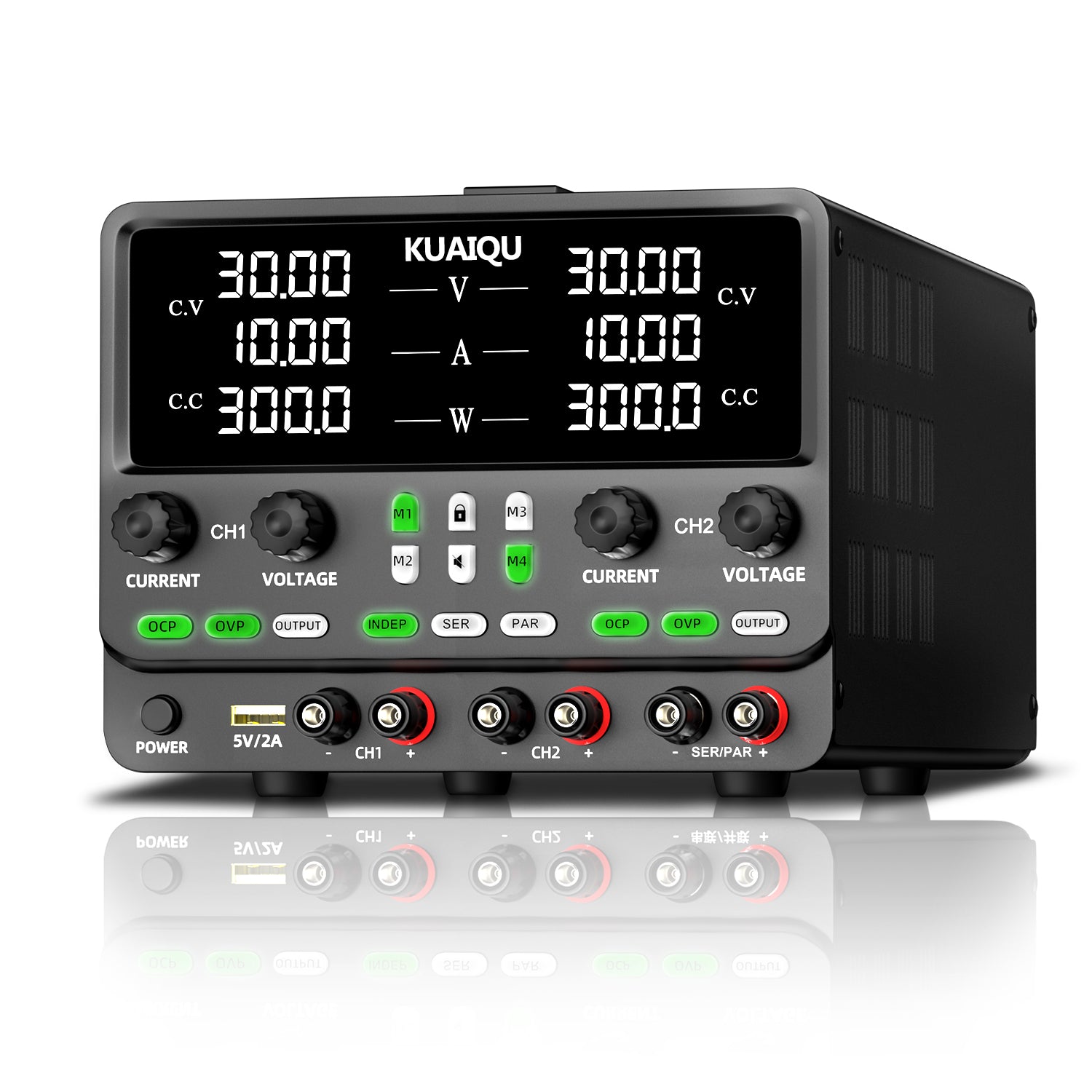

Features:
- Dual-channel output
- High-precision voltage/current control
- Programmable operation
- Memory presets
Suitable for engineers requiring independent control of multiple test conditions.
R-SPS High Power Programmable DC Power Supply
Designed for high-power applications including EV battery testing, energy storage systems, and industrial electronics validation.
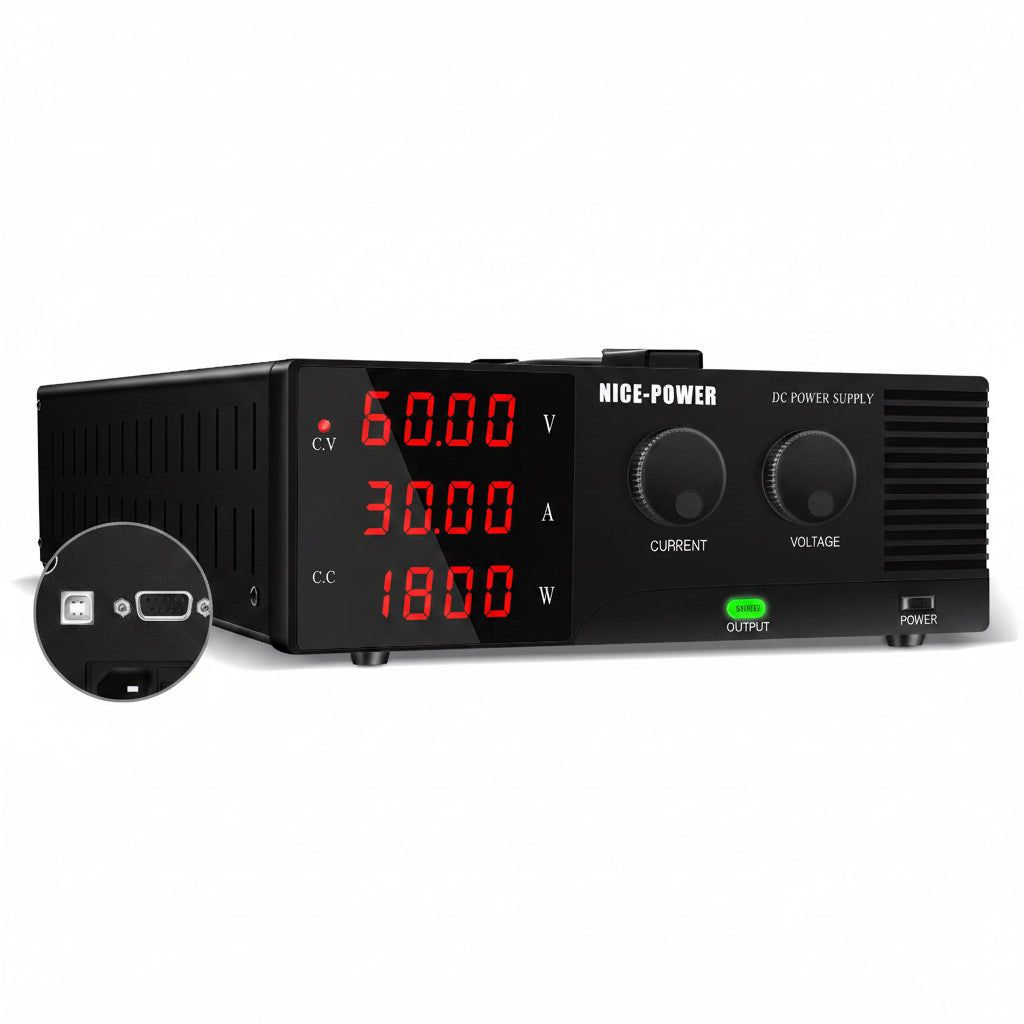
Features:
- High voltage/current output
- Programmable control
- Remote communication
- Professional protection functions
Provides stable and reliable DC power for demanding engineering environments.
|
Application |
KUAIQU Product |
|
Electronics Repair |
SPS-C Series |
|
Precision Measurement |
SPPS-K Series |
|
Battery Testing |
SPPS3010R-2KD |
|
Multi-channel Laboratory Testing |
|
|
EV / ESS / High Power Testing |
R-SPS Series |
Programmable vs Manual DC Power Supply: Final Recommendation
The best choice depends on your application.
|
Your Application |
Recommended Power Supply |
|
Electronics repair |
Manual DC Power Supply |
|
Student projects |
Manual DC Power Supply |
|
Prototype testing |
Both options |
|
Battery testing |
Programmable DC Power Supply |
|
EV/ESS testing |
Programmable DC Power Supply |
|
Automated production testing |
Programmable DC Power Supply |
|
R&D laboratory |
Programmable DC Power Supply |
For basic testing, a manual DC power supply provides excellent value.
However, if you need repeatable testing, automation, memory presets, or computer control, upgrading to a programmable DC power supply can significantly improve efficiency.
Explore KUAIQU programmable DC power supplies for your next testing project.
Frequently Asked Questions (FAQ)
1.What is the difference between programmable and manual DC power supplies?
A manual DC power supply requires users to adjust voltage and current manually, while a programmable DC power supply allows digital control, parameter storage, and automated testing.
2.Which is better: programmable or manual DC power supply?
It depends on your application. Manual power supplies are suitable for basic testing and repair, while programmable models are better for R&D, battery testing, and automated systems.
3.Why use a programmable DC power supply?
Programmable power supplies provide higher repeatability, memory presets, remote control, and precise voltage/current adjustment, making testing faster and more reliable.
4.Can a programmable DC power supply be used for battery testing?
Yes. Programmable DC power supplies are widely used for battery charging, cycling tests, BMS testing, and battery development.
5.Are programmable DC power supplies worth the investment?
For engineers who need repeatable testing, automation, and precise control, a programmable DC power supply can significantly improve efficiency and reduce testing errors.